
For a loved one with dementia, the world gradually transforms. The present often blurs with the past, and new situations create deep anxiety. In such a state, the appearance of a stranger can easily trigger fear, mistrust, or rejection. But how can a caregiver become accepted?
This article guides caregivers in building trust step-by-step with someone with dementia. We will discuss the golden rule of the first meeting, the importance of a gradual approach, the secret to building a connection, emotional attunement, conflict management in difficult situations, and how the past can become the most important point of connection. Gaining acceptance for a caregiver in the life of a person living with dementia is often a difficult task. It is natural for your loved one to resist: due to dementia, they struggle to understand changes, and a lack of trust or confusion easily triggers anxiety. It is important to know that this is not ill-will, but a consequence of declining brain functions. The key to success is patience and a gradual approach. The following steps help ensure that someone with dementia does not see the caregiver as an “intruder or dangerous stranger,” but rather as a friendly helper.
The golden rule of the first meeting: A gradual approach
The appearance of a caregiver can cause serious anxiety for a relative with dementia. The introduction should be planned.
- Step by step: During the first meeting, there should be no long stay or specific tasks. Short, pleasant shared activities (e.g., having tea or a short walk) work much better.
- Presence of a family member: In the first few weeks, a family member needs to be there—ideally the relative who spends the most time with them or someone your loved one dearly loves. If they see that the people close to them treat the caregiver with acceptance and trust, it will be easier for them to accept the situation too. The relative forms a bridge between the loved one and the new caregiver, helping to reduce anxiety.
- Timing: Choose a calm time of day for the first meeting when your loved one is less confused or tired. Avoid the late afternoon, which is often more stressful.
The past as a bridge – life-story-based care
For a person living with dementia, the present is often uncertain, fragmented, and frightening. Short-term memory is impaired, and new information is hard to retain. At the same time, old memories—especially emotionally significant life events—often remain surprisingly intact.
This is where one of the most powerful tools in a caregiver’s hands lies: the past as a point of connection. The caregiver should take the time to learn the life story of the loved one with dementia.
Why does the life-story approach work?
Person-centered dementia care—of which Tom Kitwood was a defining figure—starts from the idea that someone with dementia is defined not by their diagnosis, but by their life story.
Dementia does not erase identity. The deeper layers of personality, former roles, values, and emotional patterns live on.
If the caregiver gets to know the past of the family member with dementia, they:
- do not see a “task to be completed,”
- but rather a former teacher, mother, farmer, or artist,
- a human being who for decades made decisions, took responsibility, and created value.
This perspective in itself communicates respect.
Respecting old roles
Many conflicts arise because your loved one feels they have lost all control. However, if the caregiver addresses them in their former roles, it can provide stability:
- A former teacher can be asked, “Can you help me find my way?”
- A mother can be asked for advice while cooking.
- A craftsman can be asked: “How would you do this?”
Memories as a source of emotional security
A person living with dementia may not always remember what was said to them five minutes ago. But they remember what it felt like to be young. They remember their first home. They remember the birth of their child. Emotional memory lasts much longer than factual memory. Therefore, a caregiver’s presence can create a sense of security even if your loved one cannot name who they are.
For example:
- looking through old photographs,
- listening to familiar songs,
- using old objects,
- recalling favorite meals,
- reminiscing about youthful experiences.
How does this help with accepting the caregiver?
When the caregiver connects to the past of the relative with dementia, they do not appear as a stranger. It is not a “new person” entering their life, but someone who is interested in them. This reduces resistance because the focus is not on what is missing, but on values and strengths—not on “what they can no longer do,” but on “who they were and who they are now.”
Important: We do not correct; we connect
A core principle of life-story care is that we do not force reality, but rather connect to the emotional reality. If your loved one is “living” in a past stage of life, it isn’t always necessary to pull them back into the present. Often, it is enough to simply stay with them in that experience.
Communication
The caregiver should speak slowly, in short sentences, with a friendly tone, kindly, and with a smile. They should not correct the person living with dementia and should wait patiently for them to answer. They must be calm and patient. Someone with dementia often reacts to tone of voice and body language sooner than to spoken words. NON-VERBAL COMMUNICATION IN DEMENTIA CARE – Dementia in practice
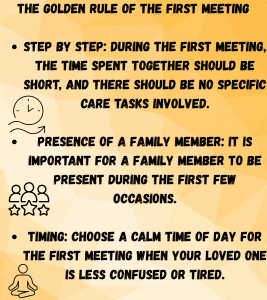
Figure 1: This diagram shows the golden rules of the first meeting: timing, a gradual approach, and the presence of a family member.
Conflict Management
If your loved one resists and does not want to accept the caregiver at all, or perhaps feels angry or anxious, the worst thing we can do is argue or force the issue.
- Do not argue: If they do not want to do something (for example, bathing or dressing), do not try to convince them with logic. They are likely still distrustful of the caregiver or simply feeling shy. Forcing the matter only increases tension. Instead, distract them and try again later.
- Shared activity: The caregiver can ask the family member with dementia for help with simple things—folding napkins, setting the table, or making tea together. This makes your loved one feel useful, and through shared activity, the caregiver can grow closer to them.
- Favorite pastimes: If they like listening to music or watching TV, the caregiver can join in.
- Complaints: Do not ignore complaints. If your loved one shows particularly negative reactions, it is worth checking if there is a genuine reason for the rejection (e.g., an unpleasant experience).
The key to success is patience and building trust. If no improvement is achieved this way, it may be worth looking for another caregiver with whom your loved one can find a better connection.
Rejection is a natural first reaction
The rejection shown by a person living with dementia is usually not directed at the caregiver personally, but at the situation. The appearance of a stranger in their reality can represent a threat: they don’t know exactly who is standing before them, what they want, or what will happen. Uncertainty breeds anxiety, and anxiety often manifests as a defensive reaction. “I don’t need you here!” or “Go away!” often actually means: “I’m afraid.”
It is important to understand that your loved one is experiencing a loss of control. They find themselves in situations they do not understand and in which they feel vulnerable. It also often happens that they project an experience from an earlier stage of life onto the present, seeing not the caregiver, but someone from their past.
In these moments, it helps to slow down, not to argue, and not to try to prove you are right. Short, calm answers and simple presence are more effective than explanations. It helps if the caregiver accepts in advance: rejection will likely happen, but it is not a sign of failure.
The best approach is to treat rejection not as a personal attack, but as a signal born of fear, and to remain calm. This calmness will eventually rub off on the loved one. Often, it is precisely this quiet persistence that finally transforms resistance into trust.
Trust is a long process
For a person living with dementia, accepting a new caregiver is a long process. It must not be rushed or forced. A gradual approach, emotional attunement, patient communication, and shared activities help your loved one accept the caregiver better and sooner.
Accepting someone with dementia doesn’t start with an introduction. It starts with showing interest. For a person living with dementia, the past is not just a memory. Often, it is the only solid ground beneath their feet. Trust is not born from an instruction. It comes from the quiet message: “I see you. Not just now, but with everything you have ever been.”
Small daily victories lead to long-term peace. This post is part of our Daily Care & Safety-Practical Guides for Dementia Caregivers – Dementia in practiceresource center, where we share creative techniques for hygiene, medication, and creating a secure home environment. Discover more practical guides to make your daily routine smoother.
Important Disclaimer
The information and advice presented on this website and in this article are for informational purposes only. They do not constitute a medical diagnosis or individual therapeutic recommendations. The operator/author of the website assumes no liability for any direct or indirect damages, health issues, or misunderstandings resulting from the use of this information. Everyone applies the described methods at their own risk. Please consult your physician before making any lifestyle changes or applying any complementary therapies.
About the Author
Suzanne Sandwiese – Dementia Caregiver, Mental Health Assistant
I have more than 12 years of practical experience in caring for elderly people and patients living with dementia. My goal is to translate knowledge about dementia into understandable, practical advice that can be applied in daily life, thereby helping families live together with the disease. As the author of several professional books and the founder of a popular Facebook page, my mission is to provide clear and, above all, usable guidance to all those who care for loved ones living with dementia.
My books – Dementia in practice
Looking for practical, hands-on guidance for caring for a loved one with dementia at home? This comprehensive guide offers real-world advice and strategies to help you navigate everyday caregiving with confidence.
Struggling with stress-free bathing, hair washing, or nail care for a person with dementia? Discover practical, empathetic techniques to turn daily hygiene routines into calm and dignified experiences.
Managing incontinence in dementia care can feel overwhelming, but the right approach makes all the difference. Learn practical, experience-based steps to maintain dignity, comfort, and routine at home.
Agitation and aggressive behaviors in dementia are often cries for help rather than intentional actions. Discover practical, practical-proven techniques to de-escalate difficult situations and create a peaceful environment.

Apathy, anxiety, and mood changes are among the hardest non-verbal symptoms of dementia to navigate. This practical guide helps you understand these emotional challenges and offers actionable steps to support your loved one.