
Tips for Encouraging Medication Intake
This blog post is about what we can do when a person living with dementia refuses to take their medication. We will detail the reasons behind this behavior and present specific, practical advice that can be applied in everyday life to make administering medication less stressful. Finally, we will discuss why it is essential to strictly follow medication therapy to treat co-existing conditions that worsen dementia, such as high blood pressure or diabetes.
When Taking Medication Becomes a Struggle
It is five o’clock in the afternoon; the time has come for the usual evening medications. You prepare the water, take out the tablets, and kindly ask your loved one to take them. However, the patient pushes your hand away, clenches their mouth shut, or simply stands up and walks away, leaving you there. No matter how much you try to explain that it is in their best interest, no matter how much you plead or argue logically, the resistance only intensifies. Because of the medication refusal, you feel helpless, having no idea what to do or how to convince your loved one with dementia to swallow the pill.
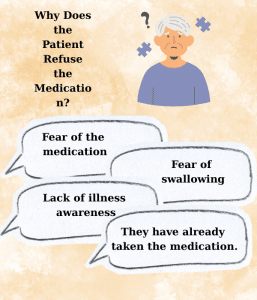
Why Does the Patient Refuse the Medication?
Dementia does not only involve forgetting; it also changes perception. There can be many reasons behind the refusal:
- Fear of the medication: Due to dementia, the patient may become suspicious. They might believe the medicine is poison and that you want to harm them.
- Fear of swallowing: The patient is afraid of choking or gagging, which is why they refuse the tablet.
- Lack of illness awareness: The patient is honestly convinced that they are not ill. “Why should I take something if nothing is wrong with me?” they think.
- Confusion: They remember that they have already taken the medicine and believe you want to give them a double dose.
- Bad taste: The tablet is too large, has a bad taste, or the water they have to swallow it with is too cold.
Practical Solutions for Successful Medication Administration
If the patient resists, the most important rule is: never force them, because forcing only increases fear and aggression. Furthermore, if they swallow under duress, there is a higher chance of choking or aspiration. Try the following:
Give it in a hidden or liquid form. Before crushing a tablet, ask the treating physician or pharmacist if the specific medication can be crushed or administered in powder form!
- Hiding in food: If the doctor allows it, crush the tablet and mix it into a spoonful of sweet food. The sweet taste masks the bitterness of the medicine, and dementia patients usually prefer sweet flavors the most.
- Liquid form: Many medications are available in drops or syrup form. Ask the doctor to prescribe these instead of tablets if possible.
- Using a teaspoon: It is often easier to take medication with a teaspoon of food than with a glass of water.
The Most Commonly Used Foods to Mask the Taste of Medication
These are the foods best suited for “hiding” medications and masking unpleasant, bitter aftertastes:
- Apricot or strawberry jam: They are very sweet, which suppresses the bitter taste, and they have a thick consistency.
- Greek yogurt: Use a thicker, higher-quality version.
- Chocolate pudding: Both store-bought and homemade are excellent.
- Applesauce: You can buy it ready-made, but it is also easy to prepare at home.
- Syrup: Any flavor is suitable.
- Honey
What to Watch Out for During “Masking”?
- Avoid large portions: Do not mix the medicine into an entire plate of food! If the patient stops eating halfway through, they will not receive the full dose. Mix it into only one or two spoonfuls of food.
- Not in the main meal: Never mix the medication into the patient’s “main meal.” If they detect the taste, they might refuse lunch next time, believing it tastes bad too.
- The last bite: Immediately after the medicated bite, give them a clean (medication-free), delicious bite or a sip of a drink so that any remaining taste of the medicine disappears from the mouth.
Show Them
In advanced stages of dementia, the patient forgets how to initiate swallowing. After the medication is in the patient’s mouth (preferably with some creamy food), point to your own throat, swallow once slowly, and stroke your throat with downward movements of your hand. In other words, show them what you expect, what they need to do.
The “Straw Method”
For many elderly people, drinking from a cup is difficult (because they cannot tilt their head back). If the medication is whole (because it cannot be crushed), try offering water or fruit juice with a straw. When using a straw, the head tilts slightly forward; they do not need to tilt their head back.
Successive Bites
Often, a dementia patient does not swallow because they feel their mouth is too dry. Dry mouth can be a side effect of medication or can develop because they have drunk too little. Give one bite of clean (medication-free) food, e.g., pudding, then give the medicated bite with the second spoon, and immediately offer a third, again clean, bite.
Choosing the Right Time
- Timing: Wait for when the patient is at their calmest. If they are currently agitated, postpone the administration and try again later (in 15-20 minutes).
- Try giving the medicine in a pleasant moment: “Link the medication” to a pleasant event, such as their favorite TV show.
Communication
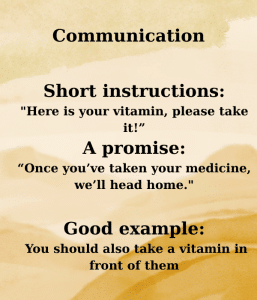
- Short instructions: Do not give long speeches, introductions, or explanations before giving the medicine. Simply say: “Here is your vitamin, please take it!” (The word “vitamin” is sometimes less scary than “medication,” so it is better to use this word).
- A promise: What does your loved one with dementia desire most? For example, to go home? Then say this: “Once you’ve taken your medicine, we’ll head home” (if they took the medicine, take a walk around the house).
- Good example: You should also take a vitamin in front of the patient, showing them that it is safe to take this pill.
Why Skipping the Medication Is Not an Option
Many relatives give up the struggle, thinking, “They have dementia anyway, does it matter if they take their blood pressure medicine?” The answer is a firm no. The symptoms of dementia can be drastically amplified by untreated co-existing diseases. If the underlying illnesses are not kept under control, the cognitive state declines much faster. For example:
- High blood pressure: If untreated, it can cause micro-strokes, which further destroy brain nerve cells.
- Diabetes: Fluctuating blood sugar levels can trigger severe confusion, fainting, and aggression.
Administering medications significantly improves the quality of life for the patient (and thus for the caregiver-relative as well). If the co-existing illnesses of the dementia patient are not treated, it is a direct path to unmanageable daily life, manifesting in increased irritability, aggression, nighttime wandering, and total refusal of cooperation.
As a relative, you may experience that the patient “can no longer be dealt with at all”: they become tense, argumentative, restless, or they withdraw completely. For example, due to a headache caused by untreated high blood pressure, the patient may have a temper tantrum while dressing, or become so confused that they no longer feel safe in their own home and constantly “ask to go home.” This tension spreads to you and the family, causing a state of constant alertness and exhaustion for the family. Skipping medications and leaving illnesses untreated leads to a drastic increase in problems.
+ Tip for Administering Medications: Keeping a Medication Log
Before you think that no one has time for this and that keeping a medication log is just an extra unnecessary task, read how useful it is and how much it can simplify YOUR life!
Why is it worth keeping a log?
- Recognizing causes: With the help of the log, you might realize, for example, that the patient refuses medication every Tuesday evening. Perhaps there was physiotherapy that day, and they were tired? Or a relative visited, and there was too much stimulation? Is it possible that when they are more tired, they don’t want to take the medicine?
- Facilitating medical consultation: When the doctor asks how the new medication is working, you don’t have to answer from memory. You can tell them exactly if there were side effects or if the new medicine helped (they were calmer, slept a bit better, etc.). This way, the doctor will know whether to change the medication or if the dose needs to be increased.
- Substitution: If someone else looks after the patient instead of you, the log provides clear instructions for them on when to give what medication and what trick was successful in administering it. Since the dosage is recorded in writing, there will be no mistake or misunderstanding about when, what, and how to give it.
How to keep the log? You don’t need to overcomplicate it; a simple lined notebook will do with the following columns:
- Date and time: When did you try to give it?
- Name and dose of the medication
- Success (Yes/No): Was the administration successful?
- Technique used: For example: “Crushed, mixed into apricot jam,” or “From a plain glass, in raspberry syrup, with a straw.”
- Reaction/Comment: Record the patient’s behavior here. For example: “Very suspicious, said it was poison,” or “Swallowed immediately with cold pudding.”
Mark the methods where the patient was cooperative with a separate color (for example, green). When nothing seems to work, just flip back to the green markings. Perhaps those proven methods will help again now.
Tell the Doctor
Although refusing medication is often psychological in dementia, a point may come when the patient is truly unable to swallow. This condition is called dysphagia (difficulty swallowing). Consult a doctor immediately if you experience the following:
- Regular “holding in”: The patient keeps the medicine or food in their mouth but is visibly unable to initiate swallowing, and it eventually flows out of their mouth.
- Weight loss, extreme lack of appetite: If the patient starts to lose weight visibly, they may be afraid of eating or swallowing.
- Dehydration: If they often cough or choke while drinking, and as a result, the patient refuses liquids as well. If they cannot be hydrated, the risk of dehydration increases.
- Coughing, throat clearing: If the patient clears their throat or coughs during or immediately after eating or drinking (this can be a sign of aspiration).
Untreated swallowing difficulties can lead to aspiration pneumonia, which occurs when food or drink enters the lungs. This is one of the most common and dangerous complications among people living with dementia.
Giving medication to a dementia patient is often a difficult task. It may happen that the patient does not understand why it is needed, refuses it, spits it out, or simply does not cooperate. Nevertheless, it is important to always try to administer the medications. Untreated illnesses (such as high blood pressure and depression) can worsen on their own and can also amplify the symptoms of dementia.
Important Disclaimer
The information and advice presented on this website and in this article are for informational purposes only. They do not constitute a medical diagnosis or individual therapeutic recommendations. The operator/author of the website assumes no liability for any direct or indirect damages, health issues, or misunderstandings resulting from the use of this information. Everyone applies the described methods at their own risk. Please consult your physician before making any lifestyle changes or applying any complementary therapies.
About the Author
Zsuzsa Szatmári – Dementia Caregiver, Mental Health Assistant
I have more than 12 years of practical experience in caring for elderly people and patients living with dementia. My goal is to translate knowledge about dementia into understandable, practical advice that can be applied in daily life, thereby helping families live together with the disease. As the author of several professional books and the founder of a popular Facebook page, my mission is to provide clear and, above all, usable guidance to all those who care for loved ones living with dementia.