
In this blog post, we explore the layers of communication that keep working even when words fail: non-verbal communication and meta-communication. You will learn why a person living with dementia understands your movements better than your sentences, and you will receive a practical guide on how to consciously manage your facial expressions, voice, and posture.
When we try to communicate or convey something to a person with dementia, it is not necessarily the meaning of our words that speaks to them, but our voice, movement, posture, facial expressions, mimicry, gestures, and the emotions behind them. These non-verbal cues hold much greater significance in communicating with a person experiencing cognitive decline than words or sentences.
THE CONCEPT OF NON-VERBAL COMMUNICATION AND META-COMMUNICATION
Non-verbal communication: This means non-linguistic communication. In this case, information is conveyed not through speech, but through body language, facial expressions, eye contact, posture, physical distance, gestures, and vocal signals. Meta-communication: Non-verbal communication that represents the content behind the speech. It conveys intention, relationship, attitude, and emotion.
WHY IS META-COMMUNICATION THE “COMMON LANGUAGE” BETWEEN THE PATIENT AND THE CARER?
When talking to someone living with dementia, we often find that even if we choose our words carefully, the reaction is still rejection. This happens because, as the disease progresses, the language centers of the brain become damaged. However, “intuition” often remains intact for a long time.
Meta-communication is the “channel” through which we express our true feelings toward the patient or the situation. The person with dementia does not necessarily understand the words, but the emotional content behind them. For example: If you are impatient but say kind words, the patient will sense the impatience. Emotions cannot lie, and people with dementia “read” our moods and feelings with incredible accuracy.
HOW DOES A PERSON LIVING WITH DEMENTIA INTERPRET THE WORLD?
The patient interprets the signs that “accompany” what you say, as well as the emotions behind the words. Therefore, they do not understand what you say, but how (non-verbal cues) and with what feeling you say it. They are better at reading signs and feelings accompanying speech than the words themselves. Become conscious of your movements, mimicry, and everything that accompanies your communication! It is helpful to learn to observe your unconscious messages and direct your non-verbal signals.
Most of the time, we forget what we are doing with our hands or face while speaking, but a person with dementia notices these unconscious signs (non-verbal communication). They feel exactly what is hidden behind our words (meta-communication). Non-verbal signals (gestures, facial expressions, movements, posture, tone of voice, etc.) must be as calming, friendly, and kind as possible.
For a person with cognitive decline, the world becomes increasingly frightening, unpredictable, and incomprehensible. In their world, the non-verbal signals and meta-communication of those around them are the only anchors. By managing non-verbal cues, you will be much more able to make the patient understand your intentions and express your will than if you tried to achieve the same with words. If you become conscious of these signs, you will reach your goals much more easily, whether it is about eating, hygiene, or taking medication.
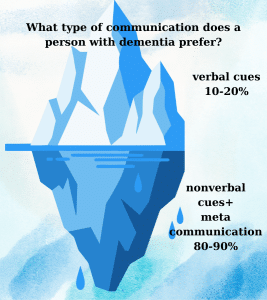
Figure 1: The graphic illustrates that while words are important for healthy people, for dementia patients, the emphasis shifts toward the “underwater,” invisible emotional signs.
NON-VERBAL COMMUNICATION INCLUDES:
- Facial expressions (Mimicry)
- Gaze (e.g., eye contact, “way of looking”)
- Movement
- Gestures
- Posture
- Voice (pitch, rhythm, strength, emphasis, intonation)
- Speech (tempo and rhythm)
- Distance (can be close or far)
- Physical appearance (clothing)
THE TOOLKIT FOR CONSCIOUS NON-VERBAL COMMUNICATION
Let’s look at our non-verbal signals one by one and what to pay attention to.
1. MIMICRY: THE FACE IS THE MIRROR OF EMOTIONS We can express many emotions with our faces, often without knowing it. Gaze: This means eye contact and the “way of looking.” The signals from our eyes are always decisive in communication. Maintain eye contact while speaking; look into the patient’s eyes, as this is the only way a connection can be established between the patient and the carer. If you want to build trust in your loved one, let your gaze meet theirs. This communicates openness, honesty, and interest toward the other person.
- Forbidden: Eye contact should not be rigid or forced. Simply look into your loved one’s eyes in a relaxed, kind way.
2. MOVEMENT, GESTURES Sudden, rushing, or flailing movements frighten a person with dementia.
- Calmness: Do not pace nervously up and down the room. Slow, deliberate movement radiates safety.
- Open palms: In body language, open palms are a sign of honesty and peaceful intentions. Avoid crossed arms or clenched fingers, as these convey closure.
- Rushing: Rushing or waving arms about appears threatening.
3. POSTURE When it comes to posture, we mean standing or sitting positions. Posture can be relaxed, stiff, or hunched. Correct posture should never be rigidly stiff, as this usually creates dislike in people. Rather, a relaxed and natural posture is what is sympathetic, trust-inducing, and therefore calming.
- Eye level: Never speak to the patient “from above,” as this indicates a position of superiority. Squat down or sit beside them.
- Leaning toward the patient: Try to adopt a natural pose, leaning slightly toward the patient, which symbolizes interest.
4. VOICE VOLUME, SPEECH TEMPO It is not what you say that is important, but HOW you say it. It is best if your voice and tone are calming and kind. Your timbre and intonation are much more important than the message itself. The speech tempo should be slow and calm. Let kindness, warmth, and understanding radiate from your speech. The words should be friendly and well-intentioned.
- Volume: Shouting or speaking too loudly can seem like aggression. Medium volume and clear articulation are the goals.
- Tempo: Slow down the speed of your speech. Hold a pause after each sentence. A person with dementia usually needs time to process what they have heard.
5. PHYSICAL DISTANCE Everyone has a personal space, which a person with dementia also senses. Generally, an arm’s length distance is appropriate.
- Closeness: A gentle touch (touching the arm) can help in getting their attention. Of course, only if the person living with dementia is not irritated!
- Safety: If the patient is angry, maintain distance.
6. THE PSYCHOLOGY OF APPEARANCE Although clothing may seem secondary at first, we also communicate through our physical appearance. Physical appearance: This refers to clothes. What certainly does not build trust is garish, colorful, or very patterned clothing. The disorder and chaos of loud, bright, patterned outfits can cause restlessness and irritation in the patient. Clothing should preferably be simple, modest, and have a “clean color scheme.”
- Clothing: A simple, pastel-colored top helps the patient focus on your face and what you are saying.
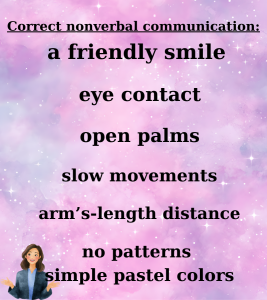
Figure 2: These external and non-verbal signs are the most calming for a person with dementia.
HOW DOES THIS LOOK IN PRACTICE?
Become conscious of non-verbal signs before you enter your loved one’s room.
1. Before you speak (Internal attunement)
- Take a deep breath: Do not bring tension into the room.
- Slow down: Make every movement half as fast as usual.
- Block out noise: Turn off the TV or radio so they focus only on you.
2. Eye contact and the face (Mimicry)
- Be at their height: Don’t speak from above! Sit next to them or squat down.
- Look for their gaze: Wait until they look at you before talking.
- The “Basic Smile”: Have a bit of natural cheerfulness, even if you are facing a difficult task.
3. Voice volume
- Voice: calming, kind.
- Hold a pause: Wait a bit after every sentence before continuing.
4. Palms, distance
- Palms: Visible, open palms.
- Personal space: Stay an arm’s length away.
5. Appearance
- Simple clothing: Preferably no vibrating patterns or overly bright colors.
WHAT NOT TO DO? – FORBIDDEN NON-VERBAL SIGNS
People with dementia are extremely sensitive to negative vibes. The following signs are often unconscious and can cause immediate tension:
1. Signs of dominance (Creates a feeling of threat)
- “Towering”: If you stand over the patient while they are sitting.
- Rushing, flailing: Makes them irritated.
- Hands on hips: This posture radiates dominance.
2. Signs of impatience (Creates anxiety)
- Checking the watch: If you look at your watch or phone during a conversation, the patient feels like a “burden.”
- Rolling your eyes: Even if it’s not meant for them, just sighing to yourself and looking at the sky is experienced as rejection.
- Drumming fingers: Rhythmic, nervous tapping on the table or shaking your leg conveys internal tension that the patient absorbs.
3. Signs of closing off (Loss of trust)
- Folded arms: This is a classic defensive pose. It says: “I am not open to you” or “I reject what you are saying.”
- Turning your torso away: If you turn toward the exit while talking, it conveys that you actually want to leave already.
How to Correct Wrong Non-Verbal Signs Immediately?
If you notice any of the above signs in yourself, simply correct them:
- Lower your hands: If you crossed your arms, just let them hang by your side.
- Relax if you are tense: If you feel tense, breathe out the air (and the tension).
- Change position: If you realize you are standing over them, simply pull up a chair.
THE SIGNIFICANCE OF NON-VERBAL COMMUNICATION AND META-COMMUNICATION
If you are calm and your non-verbal communication is kind and friendly, the person living with dementia is more likely to be calm, making it easier to care for them and live with them. In dementia care, it is important to dissolve communication barriers. When words no longer reach their target, non-verbal communication and meta-communication become the bridge connecting the relative and the patient.
If you learn to be conscious of and manage your non-verbal signals (the smile, the gaze, the tone of voice, and movements), you create a protective bubble around the patient that reduces their fear and anxiety. The conscious use of non-verbal signs is not just a technique, but the highest expression of love and respect.
More practical advice in our articles: What to Do If a Patient with Dementia Won’t Take Their Medication? – Dementia in practice
Wandering and the Urge to Move: Causes and the Impact on Families – Dementia in practice
Important Disclaimer
The information and advice presented on this website and in this article are for informational purposes only. They do not constitute a medical diagnosis or individual therapeutic recommendations. The operator/author of the website assumes no liability for any direct or indirect damages, health issues, or misunderstandings resulting from the use of this information. Everyone applies the described methods at their own risk. Please consult your physician before making any lifestyle changes or applying any complementary therapies.
About the Author
Suzanne Sandwiese – Dementia Caregiver, Mental Health Assistant
I have more than 12 years of practical experience in caring for elderly people and patients living with dementia. My goal is to translate knowledge about dementia into understandable, practical advice that can be applied in daily life, thereby helping families live together with the disease. As the author of several professional books and the founder of a popular Facebook page, my mission is to provide clear and, above all, usable guidance to all those who care for loved ones living with dementia.