
How to Communicate with Someone Living with Dementia
Keep it short, keep it simple, and avoid complicated words or long sentences. Speak clearly, be kind, and maintain eye contact.
Communication with a person living with dementia is a two-way struggle: on one hand, they may only partially understand (or not understand at all) what we are saying; on the other hand, they struggle to make themselves understood. Poor communication is often the root of conflict between a person and their family members.
In this article, we will go over the most typical communication challenges and how to handle them. We’ll discuss what “bad” communication looks like, why it’s better to be specific, and provide practical examples. Finally, we’ll explain why it’s pointless to argue, explain, or debate with a loved one who has dementia.
Communication Problems
It is common for someone with dementia to struggle to find the right words or for their sentences to seem disconnected. Their speech might become confused, and even when they are trying hard to express themselves, what they say might be completely unintelligible.
Their attention span often wanders: they may no longer be able to follow a long story and will frequently repeat the same old memories over and over. Due to a lack of concentration, conversations become shorter, and they may withdraw into silence. This is likely frustrating for both you and your loved one, as the familiar channels of communication slowly close off.
Specific communication issues include:
- Inability to express themselves clearly; confused speech.
- Saying things that don’t connect logically.
- Difficulty finding words.
- Hearing loss.
- Inability to concentrate on a topic for a long time.
- Speaking less and less.
- Inability to finish a sentence, only managing a few words.
- Repeating stories repeatedly.
Communication Techniques for Dementia
When words are no longer enough, you need to find new ways to “reach” your loved one. Successful communication here depends not just on speech, but on your body language, the environment, and simplicity. For example, it matters if you are talking down to them from above or sitting at eye level. It’s also crucial to block out background noise during a conversation.
The most important things are the “kindness in your voice” and using short, simple sentences.
How to say it:
- Face them directly when communicating.
- Get on their level. If they are sitting, you should sit too. Don’t stand over them, as talking “down” to them can feel threatening.
- Maintain eye contact while speaking.
- Use hand gestures to help them understand your meaning.
- Write it down. If your loved one can still read, use a piece of paper for your message.
- Use short, simple commands. For example: “Sit down,” “Eat your dinner,” “Close it,” or “Put it down.” Give only one step at a time.
- Keep it simple. Strip your speech down to the basics.
- Use touch to get attention. Gently and kindly touch their shoulder or arm when you start talking.
- Eliminate distractions. Turn off the TV or radio to help them focus.
- Be kind. They might not understand your words, but they perfectly understand the tone and warmth in your voice.
- Enunciate clearly. Form your words well.
- Check their hearing. A professional hearing exam may be necessary.
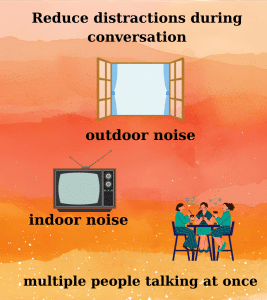
Figure 1: Block out distractions! A person with dementia has a fragile attention span. Help them focus by creating a quiet environment.
How NOT to Communicate
The following section covers how not to speak to someone with dementia. Using these wrong methods is not only ineffective but can be dangerous, as it may upset someone whose nervous system is already fragile. My “favorites” are questions like “Don’t you remember?”
Yes—they don’t remember. That is exactly the problem. That is what dementia is.
How not to say it:
- With indignation or reproach.
- In a condescending way, writing them off.
- Constantly correcting their speech.
- Talking about them as if they aren’t there.
- Turning away or standing behind their back.
- Using long, complex sentences.
- Rushing, mumbling, or speaking too softly.
- Arguing or contradicting them.
- Shaming them (“Don’t you remember?”, “Did you forget?”, “We already talked about this!”).
- Talking about multiple things at once.
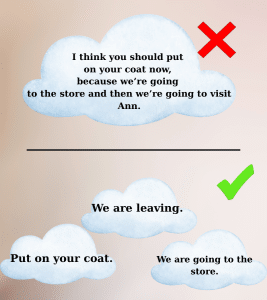
Figure 2: Provide only one piece of information at a time. Use short, simple sentences.
Be Concrete Instead of Abstract
A person with dementia often loses the ability to think abstractly; they can only understand simple, concrete things. Abstract thinking involves three main elements:
- Planning (to reach a goal)
- Judgment
- Drawing conclusions
Dementia damages all three areas. You can help maintain a connection by being specific instead of using abstract concepts. Here is what that looks like in practice:
- Don’t tell them at 10:00 AM that the physical therapist is coming at 4:00 PM. Instead, tell them 10–15 minutes before the therapist arrives. They can no longer plan or look ahead. They might spend the whole day anxious and restless, or they will forget entirely, making your early warning useless. Ten minutes’ notice is plenty.
- Don’t say while watching TV: “That woman must be a very good person because she petted that black dog and the ginger cat.” Instead, just say: “That woman likes animals.” They cannot follow the logic, the conclusion, or the complex sentence structure.
- Don’t ask: “Do you think I put enough pepper in the potatoes?” Instead, ask: “Is it tasty?” That is enough. They may not be able to form a judgment, especially in a complicated context. Keep questions simple—ideally, things that can be answered with a “yes” or “no.”
To make things smoother, “simplify yourself”: adjust your thinking, words, vocabulary, and sentences.
It’s Useless to Argue, Explain, or Contradict
The most common mistake family members make is trying to use logic and facts to convince the patient they are right. Even though it never works, many people keep trying this failed technique.
There is no point in arguing with someone living with dementia because they have lost the ability to follow logic. If you try to convince them or contradict them, you will likely just upset them and rob them of their remaining peace of mind. The person will feel their own insecurity even more; they will become agitated because they sense they did something wrong, but they won’t know what it was. Don’t create extra conflict and bad feelings.
Contradicting them or trying to convince them of something they will never understand is the “breeding ground” for aggression. Instead, accept their reality. Go with the flow rather than swimming against the current. There are many benefits to letting things go and bearing their “mistakes” without a word.
Communication with a person with dementia is fundamentally different from what we are used to. Communication doesn’t stop; it transforms. Accept that the focus has shifted from logical arguments to “meta-communication”: gestures, touch, and tone of voice become the primary channels.
If you learn this new “language,” you will be able to see and understand them more clearly. By adapting your communication to them, you can reduce daily tension and misunderstandings. Communication still works—the key isn’t what we say, but how we say it.
Important Disclaimer
The information and advice presented on this website and in this article are for informational purposes only. They do not constitute a medical diagnosis or individual therapeutic recommendations. The operator/author of the website assumes no liability for any direct or indirect damages, health issues, or misunderstandings resulting from the use of this information. Everyone applies the described methods at their own risk. Please consult your physician before making any lifestyle changes or applying any complementary therapies.
About the Author
Suzanne Sandwiese – Dementia Caregiver, Mental Health Assistant
I have more than 12 years of practical experience in caring for elderly people and patients living with dementia. My goal is to translate knowledge about dementia into understandable, practical advice that can be applied in daily life, thereby helping families live together with the disease. As the author of several professional books and the founder of a popular Facebook page, my mission is to provide clear and, above all, usable guidance to all those who care for loved ones living with dementia.