

In this article, we will talk about apathy, one of the most significant symptoms of dementia. We will go through the signs and consequences of apathy. We will discuss what we can do in case of apathy, as well as what we should avoid saying and what to say instead. We will also cover common myths regarding apathy.
Apathy means a lack of motivation or interest. Apathy is one of the most common yet most misunderstood symptoms during the illness (dementia). It is important to understand: apathy is not laziness or stubbornness; it is part of the illness caused by damage to the brain.
Typical symptoms of apathy in dementia
For someone living with dementia, apathy is often not just “being in a bad mood,” but one of the early and defining symptoms of the illness. Behavioral changes often develop gradually and significantly affect everyday life. Typical manifestations of apathy can include:
· Reduced initiative
· Loss of interest in previously important activities
· Dulled emotional responses, indifference
· Decreased internal drive to start or finish tasks
· Passivity, longer periods of inactivity
· Slowed thinking and decision-making
· Difficulty concentrating
· Social withdrawal, avoiding relationships
· Lack of interest in daily routines
· Increased sleepiness or lethargy
· Physical weakness
· Lack of interest in shared programs or family events
· More frequent physical complaints (e.g., headaches) where an organic cause cannot always be found. More about pain
: Silent Cry for Help: Recognizing Pain in Your Loved One with Dementia – Dementia in Practice
It is important to emphasize that in the case of dementia, apathy does not necessarily come with marked sadness. This is what distinguishes it from depression, for example: here, emotional emptiness and loss of motivation take center stage, rather than deep dejection.
.
Consequences of apathy in dementia
For a loved one with dementia, apathy does not merely mean a temporary lack of interest. Apathy often becomes truly visible and burdensome for those around them.
Further decline in mental state
Persistent lack of motivation and emotional emptiness can accelerate cognitive decline. Due to the decrease in mental activity, unstimulating daily life, and lack of initiative, memory, attention, and problem-solving abilities may weaken faster. Apathy also increases the risk of developing a depressive state.
Physical health decline
Lack of interest also affects the physical condition. Someone with dementia pays less and less attention to eating, moving, or personal hygiene. As a result of decreased activity, the risk of falls and weakening may increase.
Narrowing of daily activities
Due to apathy, a person living with dementia does not start activities or attend to tasks they were previously used to. This is particularly problematic in the early stages of the illness, when some independence remains.
Relationship tensions and isolation
The dulling of emotional reactions is also felt in family relationships. Your loved one reacts less to others’ joys or problems, initiates conversations less often, and shows no genuine interest. This can lead to misunderstandings and hurt feelings, which further increase the risk of isolation.
In dementia, apathy is therefore not “harmless indifference” but a symptom that, without proper support and intervention, leads to a faster decline in the condition. This is why early recognition and help are of paramount importance.
What can we do in case of apathy?
The most important thing is to talk to the doctor! Especially if apathy suddenly worsens or is accompanied by loss of appetite, significant sleep disturbance, or marked mood changes, it is worth consulting a doctor. The doctor can also treat apathy with medication if necessary.
Activities, tasks, and daily routine
Managing apathy in dementia is not about “motivation” in the classic sense. It is much more about encouraging activity.
Establishing habits
For a family member with dementia, predictable daily habits provide a sense of security. It is worth including small tasks that provide a sense of achievement, such as:
· watering plants
· setting the table
· folding clothes
· laying the table
A sense of achievement is particularly important because the self-confidence of someone living with apathy often decreases.
Familiar, previously enjoyed activities
Long-term memories can remain for a long time. Therefore, it is worth choosing occupations that connect to your loved one’s past.
· Listening to music – musical memories are often accessible in the brain for a long time. Familiar tunes evoke emotions.
· Light craft activities (drawing, simple DIY)
· Simple kitchen work under supervision (kneading dough, sprinkling powdered sugar on cake, setting the table)
· Gardening
· Petting an animal
Important: the task should be adjusted to their abilities. A task that is too difficult can cause frustration, while one that is too easy can cause disinterest.
Positive reinforcement
It is worth acknowledging even the smallest attempt.
Praise is not just emotional support; it also helps activate the brain’s reward center at a neurological level.
Reducing choice situations
Questions like “Would you like to go for a walk?” are often too difficult a decision for a loved one with dementia. In dementia, judgment and decision-making abilities are impaired, so it is easier to say no than to decide.
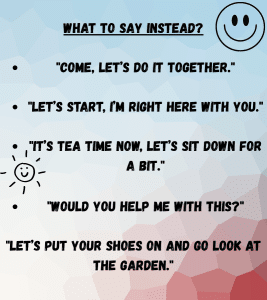
Specific phrasing is more effective, for example: “Let’s put your shoes on and go look at the garden.”
What not to say to a relative with dementia struggling with apathy?
Behind apathy lies not malice or stubbornness, but changes in brain function. Certain sentences can increase withdrawal, feelings of shame, or total passivity.
The most important shift in perspective when managing apathy is: we don’t need to “change” our loved one, but rather adjust our communication to their changed behavior. This reduces tension and creates a safer, calmer relationship in the long run.
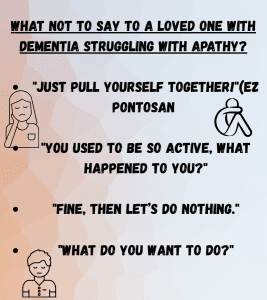
“Just pull yourself together!”
This sentence suggests that activity is merely a matter of will. However, in dementia, initiative and internal motivation decrease due to neurological reasons. Such a demand creates guilt and a sense of failure instead.
“You used to be so active. What happened to you?”
Constantly bringing up the past can be painful, especially if they perceive a decline in their own abilities. This triggers frustration and anxiety instead of encouraging action.
“Fine, then let’s do nothing.”
While it may seem empathetic at first, this can reinforce passivity. Someone with apathy will rarely initiate on their own. Instead of total withdrawal, gentle, guided encouragement to act is needed.
“What do you want to do?”
Open questions create a decision-making situation, which is taxing in dementia. The ability to plan and choose is impaired, especially in cases like Alzheimer’s. Too many options have a paralyzing effect.
What to say instead?
· “Come, we’ll do it together.”
· “Let’s start, I’m here with you.”
· “It’s tea time now, let’s sit down for a bit.”
· “Would you help me with this?”
Common myths about apathy
Myth 1: “They are just being lazy.”
· Reality: In dementia, apathy is not a matter of weak will or laziness. Due to changes in brain function, internal motivation and initiative decrease. Your loved one often wants to be more active, but the internal drive required to start an action is missing. This is particularly common in Alzheimer’s, for example.
Myth 2: “If they aren’t sad, it can’t be a serious problem.”
· Reality: Apathy is not the same as depression. While depression is dominated by dejection and sadness, in apathy, emotional emptiness, and indifference are more observable. Someone with dementia may not seem unhappy; they simply don’t react emotionally to their surroundings. Even so, the symptom is serious and impacts the quality of life.
Myth 3: “It will go away on its own.”
· Reality: In dementia, apathy is often persistent and may even increase as the illness progresses. Without help, it rarely improves spontaneously. If left unaddressed, cognitive and physical decline can also be faster.
Myth 4: “It’s just a natural part of growing old.”
· Reality: Healthy aging alone does not come with apathy. When withdrawal, loss of interest, and activity significantly decrease, it is a sign of a pathological process, especially in dementia.
Myth 5: “We don’t need to worry about it specifically because it doesn’t bother them anyway.”
· Reality: Although a loved one with dementia often does not experience apathy as suffering, the consequences are severe: self-care worsens, isolation increases, and thus it becomes harder to provide care for them. Managing apathy is therefore important not only for the person living with dementia but also for the family’s quality of life.
More helpful, practical articles on caring for a loved one with dementia: Dementia and the Decline of Self-Care Abilities – Dementia in practice
What to do if a person with dementia refuses to bathe? – Practical Solutions – Dementia in practice
Important Disclaimer
The information and advice presented on this website and in this article are for informational purposes only. They do not constitute a medical diagnosis or individual therapeutic recommendations. The operator/author of the website assumes no liability for any direct or indirect damages, health issues, or misunderstandings resulting from the use of this information. Everyone applies the described methods at their own risk. Please consult your physician before making any lifestyle changes or applying any complementary therapies.
About the Author
Suzanne Sandwiese – Dementia Caregiver, Mental Health Assistant
I have more than 12 years of practical experience in caring for elderly people and patients living with dementia. My goal is to translate knowledge about dementia into understandable, practical advice that can be applied in daily life, thereby helping families live together with the disease. As the author of several professional books and the founder of a popular Facebook page, my mission is to provide clear and, above all, usable guidance to all those who care for loved ones living with dementia.